Car repair lead form: from warning light to booked job
A lead form for garages that sorts urgent repairs from planned services, promises a callback after hours and sends every lead with the answers attached.
29 November 2026 · 6 min read
A warning light comes on during the drive home. The driver pulls over, searches "garage near me" and opens three websites. Each one has a phone number that rings out after six and a contact form that asks for a name, an email and "your message". Whichever garage makes the next step feel easiest gets the job.
A car repair lead form that asks the right questions is how that garage becomes yours. It covers what a garage website needs to ask, how to split urgent repairs from planned work, what to promise after hours, and what the morning call looks like when the lead arrives with the answers already in it.
What goes wrong with the usual contact form
Garage enquiries are short on detail. "Car making a noise, can you look at it?" is a typical message. To quote or book, you need to know what kind of noise, how soon they need the car, what the car is and how to reach them. The form asked for none of that, so the first call is spent asking questions.
There is a second problem. A blank message box gives no sense of what happens next. The driver does not know if you will reply tonight, tomorrow or next week, so they keep looking. A form that ends with a clear next step stops the search.
The four questions
The local booking template has a car repair preset built around four questions. Each one is a tap, except the last.
- What's wrong with the car? A service or MOT, a noise or a warning light, brakes or tyres, or "not sure, it just feels off". Drivers do not need to know the part name. They need to pick the thing they noticed.
- When do you need it sorted? This week, in the next two weeks, this month, or just looking for now. This answer chooses the result.
- What matters most? Price, availability, experience and reviews, or location. It tells you how to open the reply.
- Anything we should know? An optional note box, then name, email and phone.
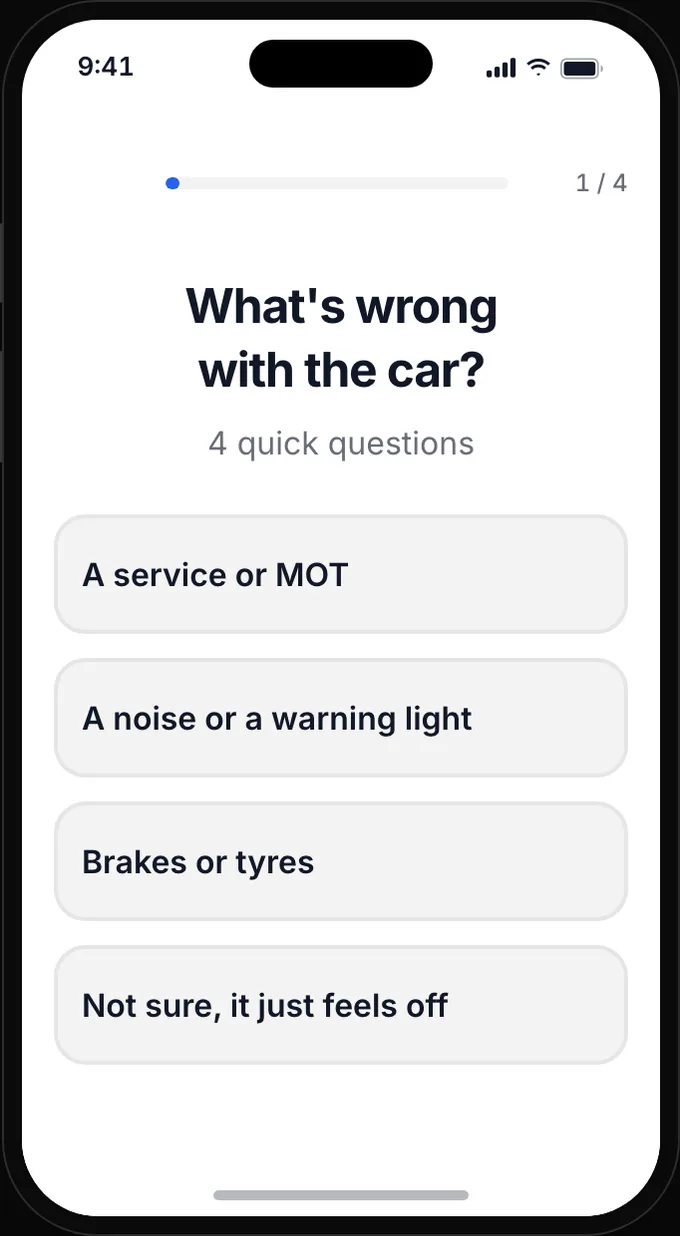 The car repair preset's first question. Drivers pick what they noticed, not the part name.
Put a hint under the note question so people know what helps: the registration number, what they hear or see ("grinding when I brake", "orange engine light"), and whether they need a courtesy car. A registration lets you look the car up before you call back.
Urgent repairs and planned work
The urgency answer splits leads into two groups, and each needs a different result.
Urgent: this week. The result promises a callback. The default line in the template is "We call you back within 30 minutes in opening hours, or by 9:00 the next morning." Set it to whatever you can keep. The phone number is a required field in this preset, because the promise depends on it.
Brakes and tyres deserve their own rule. Add one that sends them to the urgent result whatever the timing answer says, and add one honest line to it: do not drive further than you need to until it has been checked. It is the advice you would give on the phone, and it shows you take the problem seriously.
Planned: a service, an MOT, or "in the next two weeks". These jobs have a known price and no emergency, and drivers usually know roughly when theirs is due (GOV.UK's MOT guide covers the timing). Give them your booking link as the main button so they pick a slot themselves. Calendly, Cal.com or your garage software's booking page all work.
Just looking. Point the button at your price list or service menu instead. The lead still arrives in your inbox, so a friendly follow-up a few days later is easy.
What to put on the result page
The result is where the visitor decides whether to wait for you or keep searching. Keep it short and specific:
- Repeat what they told you. "Thanks, Sam. A warning light this week: we will call you back to get the car in." The template fills in their name and answers.
- Say when you will be in touch. The callback promise, in one line.
- Give them something to do now. Your number to call, a booking button, or a link to your opening hours and address.
- Mention the practical extras if you offer them. Collection and delivery, a courtesy car, or wait while you go. These often decide between two garages.
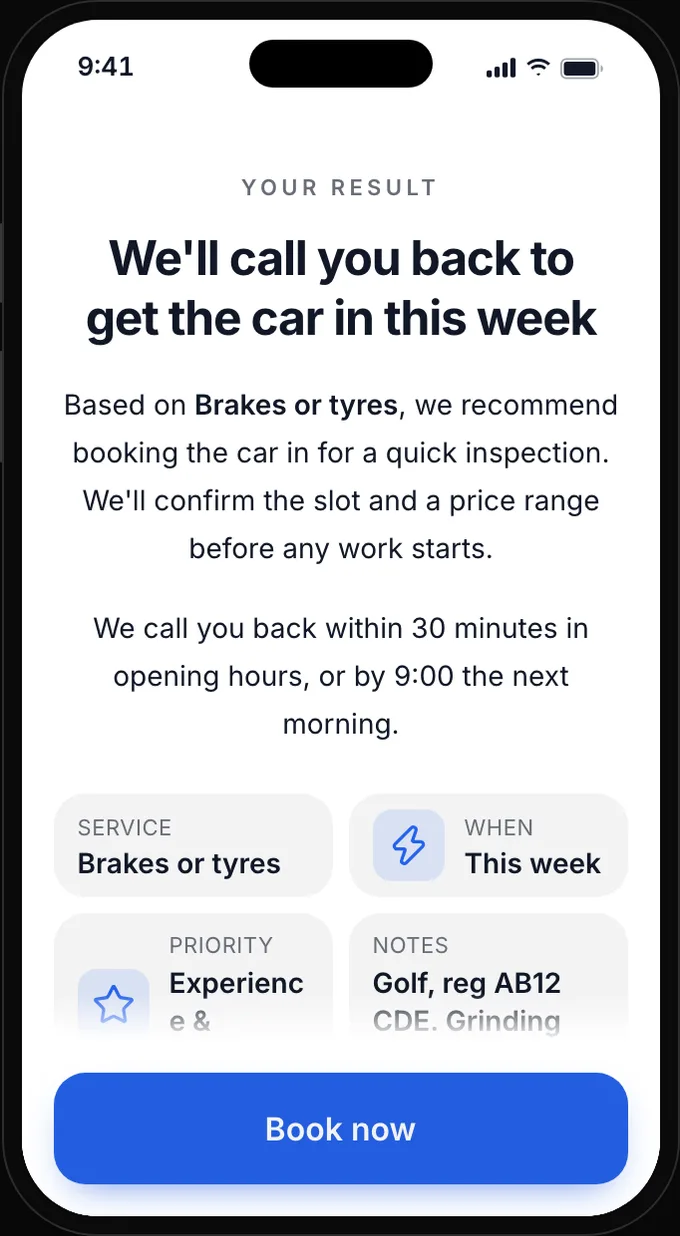 The urgent result after "Brakes or tyres" and "This week". The note with the registration comes through with the lead.
Avoid promising a price on the result page unless it is a fixed-price service. A diagnosis quote depends on the car.
Where the form goes on your site
Most independent garages have a small site on WordPress, Wix or a template builder. The quiz goes on with one script tag, without rebuilding anything. The install guides cover each platform step by step.
Three places work well:
- The contact page, as a popup opened from a "Get a quote" button beside your phone number.
- Each service page, inline, so someone reading about brake repairs can start straight away.
- Your Google Business Profile, as a hosted link in the booking or website field.
What the morning call looks like
Each lead arrives by email with the four answers, the note and the phone number. The first job of the day is to open the urgent ones and call in order.
Compare two calls. Without the form: "Hi, you sent a message about a noise. Can you tell me more? What car is it? When do you need it?" With the form: "Hi Sam, it is Hillside Auto. You mentioned grinding when you brake on the Golf, and you need it this week. We can take it at 10 tomorrow. Do you need a courtesy car?"
The second call books the job. It is shorter, it sounds like a garage that listens, and the driver does not have to repeat themselves.
Measuring whether it works
The analytics tab shows how many people start the form, how many finish each step and how many leave their details. If many people stop at one question, it is too hard to answer: rewrite the options or cut it. Compare the number of leads per week with what the old contact form produced, and ask new customers how they found you.
Swap the contact form this week
Try the car repair lead form as a driver would, with a warning light on and a phone in one hand. When you are ready, the builder with the garage preset reads your site and drafts the questions and the callback line for your garage. Add the brakes rule and your booking link, then replace the old form. It runs on the local booking template, the same one trades use for after-hours leads, and the free plan is enough to see whether it brings in more jobs.